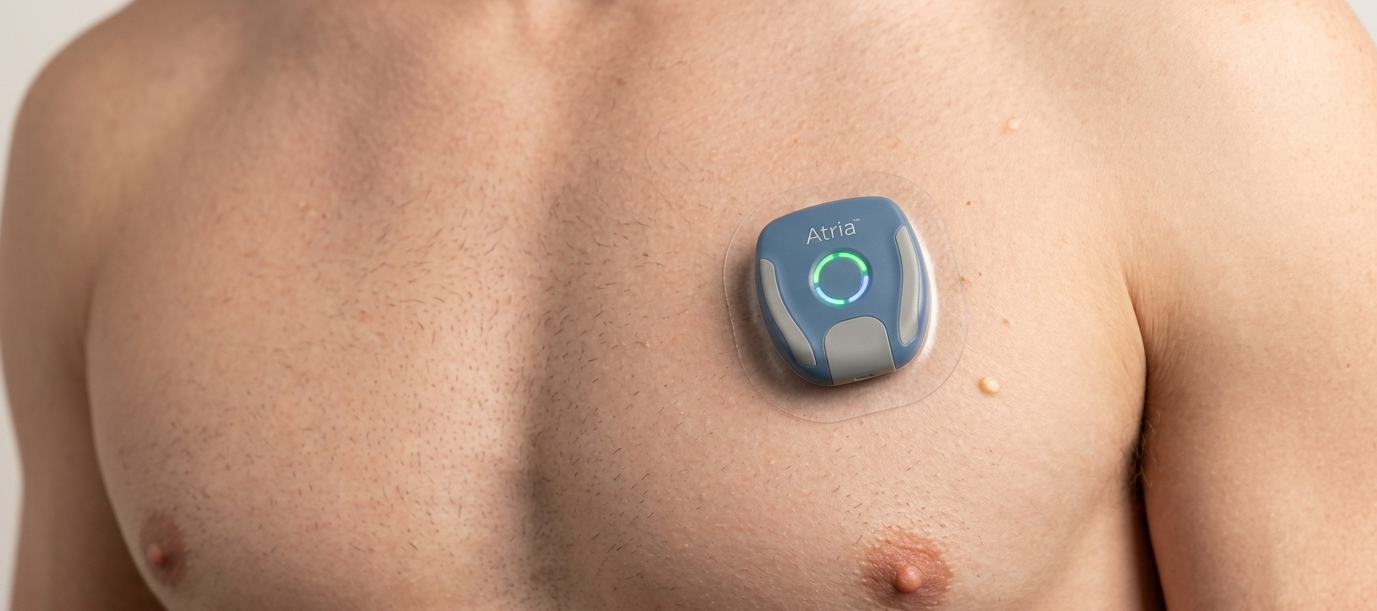
Cardiac Event Monitoring

Atria®
21-Day Event Monitor

21 days of continuous ECG recording with on-device AI that classifies arrhythmias the moment they happen — no clinic visits, no cloud dependency, no missed events.

21
Days Continuous
>93%
AF Sensitivity
38mm
Patch Size
0
Cloud Dependency
Atria® 21
Monitoring
Lead II · 25 mm/s · 10 mm/mV 72 bpm
Duration21 Days
Form Factor38 × 40 × 10 mm
AI EngineOn-device edge
ConnectivityBLE 6.0
ProtectionIP67 · Defib-proof
ReportingReal-time · Live portal

Clinical Rationale

Why 21 Days Changes Everything

Paroxysmal arrhythmias and rare conduction events are routinely missed in 24–48 hour windows. Extended continuous monitoring captures what standard Holters simply cannot.

Higher AF Detection Rate
Extended monitoring detects paroxysmal atrial fibrillation up to three times more frequently than a standard 7-day window in post-stroke and cryptogenic AF patients.
62%
Events Occur After Day 7
The majority of clinically significant arrhythmia episodes present beyond the conventional monitoring period — making extended wear a clinical necessity, not a convenience.
0
Return Visits Required
Patients apply the patch once and complete the full 21-day protocol independently. All data streams securely to the physician portal with no clinic revisit needed.
24/7
Autonomous AI Triage
On-device AI classifies every heartbeat continuously — detecting arrhythmia events within milliseconds of onset, independent of network connectivity.
Core Capabilities

Built for Clinical Precision

Six integrated sensing and intelligence systems — all in a single compact patch applied once for three continuous weeks.

ECG Monitoring
Clinical-grade single-lead ECG with continuous real-time arrhythmia detection. Validated to match standard clinical Holter recordings across rhythm analysis.
Continuous · 21 Days
Edge AI Triage
A deep learning model runs entirely on the device — detecting AF and PVC burden within milliseconds of event onset. No data leaves the patch for classification.
On-Device · No Cloud
Bio-Z Sensing
Simultaneous bioimpedance measurement enables real-time fluid status and respiration rate monitoring — a capability unique to the Atria platform in this form factor.
Fluid & Respiration
21-Day Battery Life
Ultra-low power hardware design with intelligent duty-cycling delivers the full monitoring window on a single charge — no mid-study replacement.
Extended Life
BLE 6.0 Wireless
Continuous encrypted streaming via Bluetooth Low Energy 6.0 to the companion app, with all data simultaneously logged on-device. Auto-syncs on reconnection — no data loss.
BLE 6.0 · Local Backup
Motion Compensation
Adaptive signal filtering cross-references accelerometer data with the bioimpedance reference channel — eliminating artefacts during walking, exercise, and daily activity.
Adaptive Filter

Innovation — Edge AI

How On-Device AI Triage Works

A five-stage signal processing and classification pipeline runs entirely on the patch — from raw cardiac signal acquisition through to physician-ready classified output, with no cloud dependency.

01
ECG Acquisition
High-resolution cardiac signal capture via clinical-grade analogue front-end
02
Signal Preprocessing
Baseline wander removal and bandpass filtering to isolate cardiac components
03
Feature Extraction
Beat detection and heart rate variability interval computation in real time
04
AI Inference
Quantised deep learning model classifies rhythm patterns on-device — no cloud latency
05
Classification Output
AF, PVC burden, pacemaker beats, and sinus rhythm — annotated with confidence scores and timestamp
Physician Output

Every classified event is timestamped and annotated with a confidence score, then made immediately available in the physician portal. The AI model is trained on clinical cardiac datasets — validated independently before deployment. No batch processing delay between event onset and clinical review.

AF sensitivity >93% PVC burden sensitivity >89% Pacemaker wave detection Clinically validated datasets
Clinical Performance

Validated to Clinical Grade

Core performance metrics from independent validation studies on labelled clinical cardiac datasets.

>93%
AF Detection Sensitivity
Validated across the full 21-day continuous monitoring window on independently labelled ECG datasets.
>89%
PVC Burden Sensitivity
Premature ventricular complex burden detection validated across a range of clinical burden thresholds.
<200ms
Event Detection Latency
From cardiac event onset to on-device classified output — entirely without a cloud round-trip.

Device Capability & Clinical Reference

Arrhythmias the Atria® Detects

The heart's electrical system can misbehave in many ways — too fast, too slow, too irregular, or with a completely broken signal pathway. Atria® 21 is designed to catch all of them across a full three-week monitoring window, including the rarest paroxysmal episodes that a 24-hour Holter never sees.

Supraventricular (Atrial) Arrhythmias
Origin — above the ventricles · SA node · atria · AV node
AFib
Atrial Fibrillation
Chaotic, disorganised electrical signals fire throughout both atria simultaneously, producing an irregularly irregular rhythm with no discernible P waves. The most common sustained arrhythmia in clinical practice and a leading preventable cause of ischaemic stroke.
Primary detection target
AFL
Atrial Flutter
A rapid, organised atrial rhythm — typically 250–350 bpm — that produces the characteristic "sawtooth" flutter waves on ECG. Often coexists with or converts to atrial fibrillation. Ventricular rate depends on the AV node conduction ratio.
Detected
SVT
Supraventricular Tachycardia
An umbrella term covering rapid heart rhythms originating above the bundle of His. Characterised by abrupt onset and equally abrupt termination. Includes AVNRT, AVRT, and atrial tachycardia subtypes — each with distinct ECG signatures.
Detected
PAC
Premature Atrial Contractions
Early, ectopic beats arising from foci in the atria outside the sinoatrial node. Patients describe them as a "skipped beat." Generally benign in isolation, but a high PAC burden is an independent predictor of atrial fibrillation onset.
Burden tracking
Ventricular Arrhythmias
Origin — ventricles · bundle branches · Purkinje fibres
VT
Ventricular Tachycardia
A fast, regular rhythm arising from the ventricles, typically above 100 bpm. Sustained VT prevents the ventricles from filling properly between beats, reducing cardiac output and potentially precipitating haemodynamic collapse. Always warrants urgent evaluation.
High priority alert
VF
Ventricular Fibrillation
Completely disorganised electrical activity in the ventricles — the heart quivers rather than contracts, and effective cardiac output ceases entirely. VF is the most common cause of sudden cardiac death and requires immediate defibrillation.
Emergency detection
PVC
Premature Ventricular Contractions
Ectopic beats originating in the ventricular myocardium, producing wide, abnormal QRS complexes. Occasional PVCs are common and often benign, but a burden exceeding 15–20% of total beats is associated with ventricular dysfunction and warrants further workup.
Burden >89% sensitivity
Bradyarrhythmias
Slow rhythms · <60 bpm · conduction system disease
SB
Sinus Bradycardia
A resting heart rate below 60 bpm originating from the sinoatrial node with normal P-QRS-T morphology. Physiologically normal in trained athletes and during sleep. Symptomatic bradycardia causing dizziness or syncope indicates a pathological process.
Detected
SSS
Sick Sinus Syndrome
A group of abnormalities from SA node dysfunction — including persistent bradycardia, sinus arrest, sinoatrial exit block, and tachy-brady syndrome. Intermittent symptoms make continuous long-term monitoring the gold standard for diagnosis.
Paroxysmal · high-value target
AV Block
Conduction Blocks

Impaired conduction through the atrioventricular node, graded by severity. Detected continuously across the full monitoring window — particularly valuable for catching intermittent high-degree block that a short recording would miss entirely.

1st Degree Prolonged PR interval (>200 ms) — every atrial impulse conducts, but with a fixed delay. Usually benign in isolation.
2nd Degree Some atrial impulses fail to reach the ventricles. Mobitz I (Wenckebach) shows progressive PR lengthening; Mobitz II has a sudden dropped beat — the more clinically dangerous pattern.
3rd Degree Complete AV dissociation — no atrial impulses reach the ventricles at all. An escape rhythm maintains output, but at a slow, unreliable rate. Pacemaker implantation is typically required.
All degrees detected
Pacemaker Wave Detection
Implanted device monitoring · pacing spike identification · malfunction alerting
PACE
Pacemaker Spikes
The Atria® 21 algorithm identifies pacemaker stimulus artefacts on the ECG trace and correctly classifies paced beats — distinguishing device-driven complexes from native ventricular beats, preventing artefacts from corrupting the rhythm classification model.
Spike identification
PMF
Failure to Capture
Pacing spikes not followed by a corresponding QRS complex indicate loss of myocardial capture — a pacemaker malfunction. Atria® flags these events in real time, alerting the clinical team to device underperformance that routine follow-ups would otherwise miss.
Malfunction alert
PMI
Pacemaker-Mediated Inhibition
Inappropriate inhibition of pacing output — where the device senses a spurious signal and withholds a scheduled pulse — can result in symptomatic pauses. The 21-day window captures even brief inhibition events that would not appear in a short study.
Continuous capture
Specialised Categories
Interval disorders · paroxysmal patterns · channelopathies
PAF
Paroxysmal Arrhythmia
Any arrhythmia — most commonly atrial fibrillation — that starts abruptly, lasts minutes to hours, and terminates spontaneously. These episodes are the primary clinical target for long-term event monitoring, since they reliably escape short-duration recordings.
Primary indication
LQTS
Long QT Syndrome
A repolarisation disorder characterised by a prolonged QT interval — predisposing to polymorphic VT (Torsades de Pointes) and sudden cardiac death, particularly during physical or emotional stress. QTc interval monitoring is built into the Atria® analysis pipeline.
QTc interval tracking

Competitive Advantage

The Atria Advantage Matrix

How Atria® 21 compares to current market leaders across the capabilities that matter clinically.

Capability Atria® 21 Medtronic SEEQ Philips Holter iRhythm Zio
Monitoring Duration 21 Days 14 Days1–2 Days14 Days
ECG Monitoring
Real-Time Arrhythmia Alert◎ Partial◎ Partial
Pacemaker Wave Detection◎ Partial◎ Partial
Bio-Z Fluid Monitoring
Respiration Monitoring
Edge AI (No Cloud)
Motion Compensation◎ Partial◎ Partial
Wireless StandardBLE 6.0BLE 5.xBLE 5.xBLE 5.x
Ingress / Defib ProtectionIP67 · Defib-proofIP67IPX4IP67
Form Factor38 × 40 mm~SameBulky + Wires38 × 52 mm
Open Data Platform

✓ Full   ◎ Partial   ✗ None / Unavailable

Data & Connectivity

Seamless to the Physician Portal

Every heartbeat and every classified event is securely logged and accessible to the care team — without any action required from the patient.

BLE 6.0 Streaming
Continuous encrypted transmission via Bluetooth 6.0 to the companion mobile app
Local Data Logging
All data stored on-device as backup — auto-syncs when connectivity is restored
Encrypted Transit
End-to-end encrypted data handling in line with HIPAA and GDPR requirements
Physician Portal
Live dashboard with classified events, confidence scores, and structured reports

Ready to Partner?

We are seeking clinical site collaborators, distribution partners, and grant co-applicants for the Atria® 21-Day Event Monitor programme.

Contact the Team → Research Inquiry